http://www.sidhhaherbs.blogspot.com OAK TREE
Quercus alba
 Oak wood has a density of about 0.75 g/cm3, great strength and hardness, and is very resistant to insect and fungal attack because of its high tannin content
 White oak has served as the official state tree of Illinois after selection by a vote of school children. There are two "official" white oaks serving as state trees, one located on the grounds of the governor's mansion, and the other in a schoolyard in the town of Rochelle. The white oak is also the state tree of Connecticut and Maryland. The Wye Oak, probably the oldest living white oak until it fell because of a thunderstorm on June 6, 2002, was the honorary state tree of Maryland
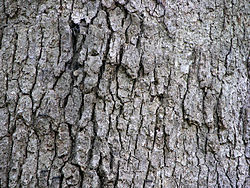
 Normally not a very tall tree, typically reaching 65–85 feet (19.5-25.5 m) at maturity, it nonetheless becomes quite massive and its lower branches are apt to extend far out laterally, parallel to the ground. The tallest known white oak is 144 feet (43 m) tall. It is not unusual for a white oak tree to be as wide as it is tall, but specimens growing at high altitudes may only become small shrubs. White oaks have been known to live up to six hundred years. The bark is a light ash-gray and peels somewhat from the top, bottom and/or sides.
The leaves grow to be 5-8.5 inches long and 2.75-4.5 inches wide and have a deep glossy green upper surface. They usually turn red or brown in autumn, but depending on climate, site, and individual tree genetics, some trees are nearly always red, or even purple in autumn. Some brown, dead leaves may remain on the tree throughout winter until very early spring. The lobes can be shallow, extending less than halfway to the midrib, or deep and somewhat branching. The acorns are usually sessile, and grow to 0.5-1 inch in length, falling in early October.

Uses
Quercus alba
 White oak has served as the official state tree of Illinois after selection by a vote of school children. There are two "official" white oaks serving as state trees, one located on the grounds of the governor's mansion, and the other in a schoolyard in the town of Rochelle. The white oak is also the state tree of Connecticut and Maryland. The Wye Oak, probably the oldest living white oak until it fell because of a thunderstorm on June 6, 2002, was the honorary state tree of Maryland
Quercus alba, the white oak, is one of the pre-eminent hardwoods of eastern North America. It is a long-lived oak of the familyFagaceae, native to eastern North America and found from southern Quebec west to eastern Minnesota and south to northern Florida and eastern Texas. Specimens have been documented to be over 450 years old.
Although called a white oak, it is very unusual to find an individual specimen with white bark; the usual color is a light gray. In the forest it can reach a magnificent height and in the open it develops into a massive broad-topped tree with large branches striking out at wide angles.
 Normally not a very tall tree, typically reaching 65–85 feet (19.5-25.5 m) at maturity, it nonetheless becomes quite massive and its lower branches are apt to extend far out laterally, parallel to the ground. The tallest known white oak is 144 feet (43 m) tall. It is not unusual for a white oak tree to be as wide as it is tall, but specimens growing at high altitudes may only become small shrubs. White oaks have been known to live up to six hundred years. The bark is a light ash-gray and peels somewhat from the top, bottom and/or sides.
 Quercus alba

Quercus alba, the white oak, is one of the pre-eminent hardwoods of eastern North America. It is a long-lived oak of the familyFagaceae, native to eastern North America and found from southern Quebec west to eastern Minnesota and south to northern Florida and eastern Texas. Specimens have been documented to be over 450 years old.
In spring the young leaves are of a delicate, silvery pink and covered with a soft, blanket-like down. The petioles are short, and the leaves which cluster close to the ends of the shoots are pale green and downy with the result that the entire tree has a misty, frosty look. This condition continues for several days, passing through the opalescent changes of soft pink, silvery white and finally yellow green.
Quercus alba is sometimes confused with the swamp white oak, a closely related species, and the bur oak. The
Uses
White oak has tyloses that give the wood a closed cellular structure, making it water- and rot-resistant. Because of this characteristic, white oak is used for barrels for wine and whiskey production since it resists leaking. It has also been used in construction, shipbuilding, cooperage, agricultural implements, and in the interior finishing of houses.[3]
It was a signature wood used in mission style oak furniture by Gustav Stickley in the Craftsman style of the Arts and Crafts movement.[citation needed]
White oak is used extensively in Japanese martial arts for some weapons, such as the bokken and jo. It is valued for its density, strength, resiliency and relatively low chance of splintering if broken by impact, relative to the substantially cheaper red oak.
The acorns are much less bitter than the acorns of red oaks. They are small relative to most oaks, but are a valuable wildlife food, notably for turkeys, wood ducks, pheasants, grackles, jays, nuthatches, thrushes, woodpeckers, rabbits, squirrels and deer. They were also used for food by Native Americans. The white oak is the only known food plant of the Bucculatrix luteella and Bucculatrix ochrisuffusa caterpillars.
The young shoots of many eastern oak species are readily eaten by deer.Dried oak leaves are also occasionally eaten by white-tailed deer in the fall or winter. Rabbits often browse twigs and can girdle stems.
The USS Constitution is made of white oak, and reconstructive wood replacement comes from a special grove of Quercus albaknown as the "Constitution Grove" at Naval Surface Warfare Center Crane Division.
Woodworkers should be aware that ferrous metal hardware reacts with oak, causing corrosion and staining the wood. Brass or stainless steel fittings should be used instead.
Symbolism

White oak has served as the official state tree of Illinois after selection by a vote of school children. There are two "official" white oaks serving as state trees, one located on the grounds of the governor's mansion, and the other in a schoolyard in the town ofRochelle. The white oak is also the state tree of Connecticut and Maryland. The Wye Oak, probably the oldest living white oak until it fell because of a thunderstorm on June 6, 2002, was the honorary state tree of Maryland.
Being the subject of a legend as old as the colony itself, the Charter Oak of Hartford, Connecticut is one of the most famous white oaks in America. An image of the tree now adorns the reverse side of the Connecticut state quarter.
 | Wikimedia Commons has media related to: Quercus alba |
Chemistry
Grandinin/roburin E, castalagin/vescalagin, gallic acid, monogalloyl glucose (glucogallin) andvaloneic acid dilactone, monogalloyl glucose, digalloyl glucose, trigalloyl glucose, ellagic acid rhamnose, quercitrin and ellagic acid are phenolic compounds found in Q. alba.
Garden Uses
Large shade tree, street tree or lawn tree. Needs a large space in which to grow.
physciapackiam

 Gum Arabic


