Monday, April 30, 2012

Malaysian Herbs (18) BANYAN ஆல மரம்

google.com, pub-7876390333399498, DIRECT, f08c47fec0942fa0

http://www.sidhhaherbs.blogspot.com

Ficus Benghalensis  

லமரம்

The Banyan Tree at Fort Myers

A Banyan tree is a fig which has the ability to spread out laterally from the original by using aerial prop roots.
Old trees can cover a very large area. The largest are found in Kolkata in India.
The tree at Fort Myers Florida was planted by Thomas Alva Edison in 1925. It covers 400 feet and is the third largest in the world.
It is also known from the story of Robinson Crusoe, who in the novel by Daniel Defoe builds his home in a Banyan tree.

In our country Malaysia there were few seen at the Ipoh railway station and in Batu Caves K.L.
But alas most of them were cut down by our people!
It can be grown for shades in parks


 Indian Banyan or Ficus benghalensisThe national tree of India.
 Banyan is a very huge structure, long and deep roots and branches symbolize the country's unity. One can find banyan trees in throughout the nation. The huge sized tree acts as a shield, protects from hot sun. This is the reason why the tree is planted near homes, temples, villages and roadsides. In the rural parts of the country, banyan tree is considered as the focal point of the Panchayats and the gathering place for village councils and meetings. 
The tree is also considered sacred by the Hindus of India. With high medicinal value, banyan is often used as a herb to treat and cure many diseases. Given below is the description of banyan, the national tree of India. 

Importance In The Indian Culture

The tradition of worshipping 'sacred' trees is prevalent among the people following Hinduism, since ages.
 Rig Veda and Atharva Veda stipulate that trees should be worshipped, for their inevitable role in human life. Banyan is considered one among the sacred trees.
 In the Hindu mythology, Lord Shiva is sometimes depicted sitting in silence, under the banyan tree, with the saints sitting at His feet. With its seemingly unending expansion, the banyan tree symbolizes eternal life. In Hindu culture, the tree is often called 'kalpavriksha', a Sanskrit word, which means 'a divine tree that fulfills wishes'. Married Hindu women worship the banyan tree to lead a long and happy married life.

 Features

Banyan tree is characterized by a tangle of branches, roots and trunks. The tree is deeply rooted, which may spread across several acres. It is huge in size, thereby giving protection from hot sun. The tree bears fruits that look like figs. The fruits, which appear red in color when matured, are not edible. The dark green leaves of the tree are large and leathery. This is the reason why, the leaves are used as animal fodder. The flowers produced by the tree often attract wasps, for pollination. An old banyan tree can reach more than 656 feet in diameter and can be as tall as 98 feet. The rubber, produced from the sticky milk of banyan tree, is used for gardening.

  • The name 'banyan' is derived from Banias, who rested under the trees to discuss their strategies regarding business.
  • The widest tree in the world - the Great Banyan - is located in Kolkata. The tree is about 250 years old.
  • Historical records say that Alexander the Great camped under a banyan tree that was large enough to provide shelter to his army of 7000 men.
  • In many parts of the world, the wood and bark of the banyan tree are used for making paper.
  • People even make use of the roots of the tree to make ropes, in order to secure wood bundles.
  • The sap produced by the banyan tree is often used to produce shellac, a strong adhesive. It can also be used to make surface-finisher.
  • Women in Nepal crush the root of the banyan tree with a paste to make a herbal product, which is used by them as a hair and skin conditioner.
  • In India and Pakistan, the twigs of the banyan tree are sold as toothpicks to promote dental health.
  • Banyan tree is well known for its medicinal uses. Its sap is a medicine for treating external skin inflammations and bruising, dysentery, toothaches, and ulcers. Its bark and seeds are used to produce a herbal tonic that can cool the body. Diabetic patients are also treated by the tonic made from a banyan tree. Thanks to Slovenia
  • physicianpackiam
  • http://www.sidhhaherbs.blogspot.com

                                                                           (18)

Sunday, April 29, 2012

Malaysian Herbs (17) அரச மரம் Ficus Religiosa

google.com, pub-7876390333399498, DIRECT, f08c47fec0942fa0

Ficus Religiosa       அரச மரம் 


ArasaMaram Instagram posts (photos and videos) - Picuki.comHello Friends! Have you ever seen this tree?

Yes it is very commonly seen! But how many of you have wondered to find out the benefits of this valuable tree?

  Hindu Sathus still meditate beneath sacred fig trees, and Hindus do Pradakshina (circumambulation) around the sacred fig tree as a mark of worship. Usually seven pradakshinas are done around the tree in the morning time chanting "Vriksha Rajaya Namah", meaning "salutation to the king of trees."

Ficus Religiosa is a species of banyan fig  and is a tropical tree. It is  native to India Sri Lanka, southwest China and Indochina, and tropical countries.  It belongs to the Moraceae  Buddhist legend tells of Gouthama Buddha attained Enlightenment  (Nganam) while meditating underneath the Bodhi Tree ,  Ficus religiosa. The site is in present day Bodh Gaya, northern India. The Bodhi tree and the Sri Maha Bodhi propagated from it are notable specimens of Sacred Fig. The known planting date of the latter, 288 B.C.E.  gives it the oldest verified age for any flowering  Mulberry trees. 

Ficus Religiosa is a large, fast growing deciduous tree. It has a heart shaped leaves. It is a medium size tree and has a large crown with the wonderful wide spreading branches. It shed its leaves in the month of March and April. The fruits of the Peepal are hidden with the figs. The figs are ripening in the month of May. The figs which contain the flowers grow in pairs just below the leaves and look like berries. Its bark is light gray and peels in patches. Its fruit is purple in color. It is one of the longest-living trees.


Medicinal uses: Roots are used for gout and chewed to prevent gum diseases. The leaves are used in treating constipation, mumps, boils, palpitation, and cardiac weakness. A paste of the leaf is applied on wounds and bruises. The bark is administered for jaundice, gonorrhea, ulcers, and excessive urination. Seeds and fruits are good for VDs, and early ejaculation, and also increase spermatozoa. Peepal root is mainly used for neck problems and swollen lymphatic glands. It is usually applied to the affected part.  


 Will our citizens make use of this sacred tree?physicianpackiam                           (17)                                             


Sunday, April 22, 2012

Malaysian Herbs- (16)Solanum Trilobatum தூதுவேளை

google.com, pub-7876390333399498, DIRECT, f08c47fec0942fa0
    http://www.sidhhaherbs.blogspot.com
    Malaysianherbs                   
                                                 Solanum trilobatum
தூதுவேளை
                               THUTHUVELLAI
    
                       Siddhar's kaaya kalpa plant

அன்பர்களே பலபேர்களின் ஆசையைப் பூர்த்திப்பண்ணும் வகையில் இதனைப் படமாகவும் பிரசரித்துள்ளோம்.

Thuthuvelai one of the kaaya kalpa plant plays an important part in neutralizing our 3 thoshas such as Vaatha -Pithaa-Kabha. 

By taking this herb as chutney in our food or as rasam -Indian soup or by whatever means it does good to your body. 

It regulates your blood flow and vitalizes your lazy body. Gives an energetic feeling after a fever or any viral sickness.

Common name: Purple Fruited Pea Eggplant, Thai nightshade • Marathi: mothiringnee, thoodalam • Tamil: Tuduvalai, Nittidam, Sandunayattan, Surai • Malayalam: tutavalam, putharichunda, putricunta, puttacunta, tudavalam • Telugu: alarkapatramu, kondavuchinta, mullamusti • Kannada: Kakamunji, Ambusondeballi • Oriya: bryhoti •Sanskrit: achuda, agnidamani, agnidamini, Alaska, vallikantakarika .


Purple Fruited Pea Eggplant is a thorny creeper with a bluish violet flower, more commonly available in Southern India has been used traditionally in the Siddha system of medicines to treat various diseases. This species is globally distributed.
Some times back each Indian reserved this plant and made use of it. Nowadays it is rare to get. 
My father planted it as a beautifying creeper in front of our house. With the small fruits hanging like small grapes, the color was attractive. But at that age, i used to play with the fruits.
 When making a paste as thuvaiyal  or Indian soup the bitterness cannot be felt. 
 In one study, aqueous methanol and n-butanol extracts of aerial parts of Solanum trilobatum L.
(Solanaceae) were tested for antimicrobial activity by the disc diffusion method. From the results, it was
found that extracts from leaves, flowers, stems, and fruits revealed antimicrobial activity against Gram (+)
and Gram (-) bacteria. Maximal antibacterial activity was seen against Klebsiella with aqueous extract
whereas methanol extract of stem showed maximal activity against Staphylococcus aureus. The
Minimum Inhibitory Concentration (MIC) exhibited by S. trilobatum aqueous extracts against tested
organisms ranged between 0.06-0.5 mg/ml. The presence of tannins, saponins, flavanoides, phenolic
compounds, cardiac glycosides, and carbohydrates indicates S. trilobatum, is one of the potential
medicinal plants for therapeutic use.
physicianpackiam

      (16)

Monday, April 9, 2012

Malaysian Herbs-(15)SEETHA சீத்தாப்பழம்

google.com, pub-7876390333399498, DIRECT, f08c47fec0942fa0
http://www.sidhhaherbs.blogspot.com
Graviola- Annona muricata 
சீத்தா பழம்  
Kills cancer cells. Relieves depression

அன்பர்களே பழங்கள் கிடைக்கும் காலங்களில் அப்பழங்களை வாங்கிச்சாப்பிட்டு பலன் அடைவீர்

 In Malaysia, we can see these trees  in  kampongs  (villages) 

Annona muricata is a member of the family of Custard apple trees called Annonaceae and a species of the genus Annona known mostly for its edible fruits Anona. Annona muricata produces fruits that are usually called Soursop due to its slightly acidic taste when ripe
So this triggers our bilious system and causes a slight dizziness if eaten abundantly.
 Gastric patients are not advised to eat a lot.

 A. muricata trees grew natively in the Caribbean and Central America but are now widely cultivated and in some areas, escaping and living on their own in tropical climates.The Soursop (Annona muricata) is a broadleaf, flowering, evergreen tree native to Mexico, Cuba, Central America, the Caribbean, and northern South America: Colombia, Brazil, Peru, and Venezuela. Soursop is also native to sub-Saharan African countries that lie within the tropics. Today, it is also grown in some areas of Southeast Asia. It was most likely brought from Mexico to the Philippines by Other common names include: guanábana (Spanish), graviola (Portuguese), Brazilian pawpaw, guyabano, corossolier, guanavana, toge-banreisi, durian benggala, nangka blanda, sirsak, and nangka londa. [2] In Malayalam, it is called mullaatha, literally thorny custard apple. The other lesser-known Indian names are shul-ram-fal and hanuman fal. In Sri Lankan mythology, Lord Rama and his disciple Hanuman are believed to have consumed this fruit on their way to Lanka. way of the Manila-oughout the world.

In Mexico and Colombia, it is a common fruit, often used for dessert as the only ingredient, or as an agua fresca beverage; in Colombia, it is a fruit for juices, mixed with milk

.Graviola has been found in in vitro studies to have anti-cancer potential. In Guadeloupe, the fruit is eaten regularly and there is concern that consumption of this fruit regularly for years and decades can lead to a Parkinsonian-like syndrome  

Our ancestors have already written in palm leaves that taking too much of Seetha  Fruit often causes the imbalance of brain  . It is not recommended to eat a lot.   But when you get it please do eat some!

 Ice cream and fruit bars made of soursop are also very popular. The seeds are normally left in the preparation, and removed while consuming.

Soursop is also a common ingredient for making fresh fruit juices that are sold by street food vendors. In the Philippines, it is called guyabano, obviously derived from the Spanish guanabana, and is eaten ripe, or used to make juices, smoothies, or ice cream. Sometimes, they use the leaf in tenderizing meat. In Vietnam, this fruit is called mãng cầu Xiêm in the south, or mãng cầu in the north, and is used to make smoothies, or eaten as is. In Cambodia, this fruit is called tearb barung, literally "western custard-apple fruit." In Malaysia, it is known in Malay as durian belanda and in East Malaysia, specifically among the Dusun people of Sabah, it is locally known as lampun. Popularly, it is eaten raw when it ripens. Usually, the fruits are taken from the tree when they mature and left to ripen in a dark corner, where they will be eaten when they are fully ripe. It has a white flower with a very pleasing scent, especially in the morning. Thanks to Wiki 
physicianpackiam             (15)


Wednesday, April 4, 2012

Malaysian Herbs (14) Eugenia jambos நாவற்பழம்

google.com, pub-7876390333399498, DIRECT, f08c47fec0942fa0
 Eugenia jambos                     நாவற்பழம் 

         www.malaysianherbalmedicine.com

உங்கள் தேவைகளுக்கு எப்பொழுதும்  எம்மை அணுகலாம்

 Jambul is also known as Jambhul/jambu/jambula/jamboolaJava plumjamun,jaam/kalojaamjamblangjambolanblack plumDamson plumDuhat plumJambolan plum, or Portuguese plumMalabar plum may also refer to other species of Syzygium
.
This fruit is called Neredu Pandu in Telugu Naaval Pazham in Malayalam and Navva Pazham in Tamil.

  It has been spread overseas from India by Indian emigrants and at present is common in  tropical British colonies  like Malaysia


Jambul (Syzygium cumini) is an evergreen tropical tree in the flowering plant family Myrtaceae, native to Bangladesh, India, Nepal, Pakistan,  and Indonesia. Portuguese Plum. "Malabar plum" may also refer to other species of Syzygium.

It is also grown in other areas of southern and southeastern Asia including the Philippines, Myanmar, and Afghanistan. The tree was also introduced to Florida, USA in 1911.

 Even in Malaysia our Indians have brought them from India and planted them. Some years back there were a lot of big trees along the roads and in the turnings of the  Malaysian roads. Since they are huge trees they will not fall off for rain and thunder. But all were cut off now.

  In Brazil, where it was introduced from India during Portuguese colonization, it has dispersed spontaneously in the wild in some places, as its fruits are eagerly sought by various native birds such as thrushes, tanagers, and the Great Kiskadee. Not only do birds need it; This tree's fruit saves us humans from diabetics.

A fairly fast-growing species, it can reach heights of up to 30 m and can live more than 100 years. Its dense foliage provides shade and is grown just for its ornamental value. The wood is strong and is water-resistant.

Because of this it is used in railway sleepers and to install motors in wells.

It is sometimes used to make cheap furniture and village dwellings though it is relatively hard to work on.
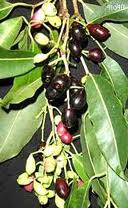
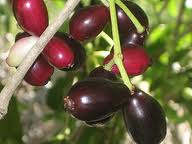
Jamun trees start flowering from March to April. The flowers of Jamun are fragrant and small, about 5 mm in diameter. The fruits develop by May or June and resemble large berries. The fruit is oblong, ovoid, starts green, and turns pink to shining crimson black as it matures. A variant of the tree produces white-coloured fruit. The fruit has a combination of sweet, mildly sour, and astringent flavors and tends to color the tongue purple.

Medicinal Use

 The seed is used in various alternative healing systems like Ayurveda and Siddha  [to control diabetes],  Unani, and Chinese medicine for digestive ailments. The leaves and bark are used for controlling blood pressure. Even to stop the leakage of urine these fruits and barks are recommended. As a seasoning fruit, you can eat as much NAVAL PAZHAM as possible. It won't do any harm. The heart will be strengthened.

Wine and vinegar are also made from the fruit.
 It is a high source of vitamin A and vitamin Source wiki


Jamun fruit, which is known in Tamil as Naaval Pazham or Nagapazham, also called Java Plum, Black Plum, Jambul, and Indian blackberry is a precious but humble fruit.
It is rich in iron, minerals, vitamin A, and vitamin C and also acts as a coolant and induces digestive power.
The fruit is said to be good for diabetics and also for the purification of blood. The seeds are used in Ayurvedic and Unani medicines for digestive ailments.
Even Diabetics can consume this fruit or drink its juice without increasing the sugar level.
physicianpackiam


                        (14)                                                                                                                               

Monday, March 26, 2012

Malaysian Herbs (13) Morinda citrifolia- Noni fruit நுணா மரம்

google.com, pub-7876390333399498, DIRECT, f08c47fec0942fa0
 http://www.sidhhaherbs.blogspot.com

 NONA  FRUIT         Morinda citrifolia                        நுணா


Hello! My friends! I am here to share with you some new ideas. We all know this Nona or Noni or Nuna in Tamil. This tree is well-grown in Malaysia. We can see it in most of our Malay friend's houses. They seem to use it every day, without knowing the full effect of the fruit. 
Let me tell you some more things I have gathered. Please do use it in your house needs and get the benefit of it.


 Noni fruit comes from Southeast Asia, but because of its recent boom, it’s traveled around the world to Hawaii, India, the Pacific Islands, and French Polynesia, among other places where it can survive and thrive. It’s spread around the world and frequently eaten in other places, but as a fresh fruit, it lacks popularity for a couple of reasons: it’s a tropical mystery, and because it’s so stinky. Yes, this fruit has gotten a nickname as the “cheese fruit” because of its pungent odor. The taste could be similarly described, which is why it’s often masked with other fruit juices.
The biggest question when deciding if something is a superfood or not is the obvious: What benefits can you get from noni juice? In short, almost everything, but let’s expound. Noni fruits have many components to boost the body. Polysaccharides and antioxidants help the immune system and act as an anti-bacterial and reduce the risk of cancer in the body by destroying the free radicals. Research also shows that noni lowers cholesterol by inhibiting the creation of it in the first place. A chemical in the juice–scopoletin–also binds to receptors in the body that are linked to blood pressure, keeping it safe and low.
As with genies, however, super foods have drawbacks and limitations. The high concentration of vitamins can be harmful to certain people. Those with hyperkalemia ( High potassium)should monitor their intake of noni for the levels of potassium. People on blood pressure medicine in general should consult their doctors before going on any sort of diet with noni juice, as the natural chemicals may inhibit or alter the effect of the medicine.
Parts of the noni plant are used as a juice, a tonic, a poultice, and in tea. The juice, which has an unpleasant taste and odor, is used on the scalp as a treatment for head lice. Some proponents also advise drinking the juice, mixed with other juices and flavorings to mask its unpleasant taste. The leaves and bark are sometimes made into a liquid tonic for urinary complaints and muscle or joint pain. The unripe noni fruit is mashed together with salt and applied on cuts and broken bones. Ripe fruit is used as a poultice for facial blemishes or as a remedy for skin sores, boils, or infections. Tea made from the leaves of the plant is used as a remedy for tuberculosis, arthritis, and rheumatism, and as an anti-aging treatment.
physicianpackiam
       http://www.sidhhaherbs.blogspot.com                       (13)

Sunday, February 19, 2012

Malaysian Herbs (12) KARPURA VALLI கற்பூர வள்ளி

google.com, pub-7876390333399498, DIRECT, f08c47fec0942fa0
COLEUS AMBONICUS
 KARPURA VALLI  கற்பூரவள்ளி


Good morning everybody! Today I am bound to talk about our children's phlagm.  We are Malaysians. We must be out of being sick at the early stages because we are living in a fertile greenery-covered country. Our air is not polluted yet. So our children must be healthy. If they are not then we are not following our forefather's ways. Right?

Where were we slacked? O.k. I will tell you. Are we bathing our children daily head to foot? Oh no. You are admitting the truth. You are scared that they will get the flu? Do not mistake me. We are living in a tropical country. Our bodies are hot. We must bathe from head to feet every day.; not just lub our body or bathe till the neck. It is wrong to do since this will make your head heat up.

Well if your child is given cooling oils such as  Agasthiar Kannai Ennai and daily bath with Agasthiar Neer Korvai Oil or  Agasthiar  Herbal Oil then your child's body is being cooled down. Only heaty bodies tend to get sick.

கற்பூர வள்ளிச் செடியின் அற்புதங்கள் பல உள்ளன. அப்படியே 2 அல்லது 3 இலைகளை மென்று சாப்பிட்டு வரலாம். அல்லது 4,5 இலைகளைச் சாறு எடுத்துக்குடிக்கலாம்.

Coleus Ambonicus or Karpuravalli is a plant to be grown in every house where there are children and Asthmatic patients. We recommend that infants to given a small dosage of the juice after the oil bath as prescribed by the physician. You may give this juice with a medicine. This is mainly used to treat cough and cold. It is antibacterial and anti-tubercular. It posses muscle relaxant actions.This increases the absorption of nutrients. The leaves prevent gas formation also.
So please wherever you stay, take some herbs from your country boil them, and bathe with that water to drive away your body pain. You may take juice and drink it whenever you have phlegm. Please try to understand the value of the herbs near your houses. God has created near your house to feed you or help you when you are in need.
   So dear dear friends do not ignore herbs. Herbs are the valuable pearls of the ground we live. Do respect them. Appreciate them. We will be blessed by them. Yours Sincerely
physicianpackiam

 www.malaysianherbals.com                                                                                                                                  (12)

Wednesday, February 8, 2012

Malaysian Herbs (11)Psyllium Husk இஸ்போகல்

google.com, pub-7876390333399498, DIRECT, f08c47fec0942fa0
http://www.sidhhaherbs.blogspot.com

Psyllium husk (Plantago psyllium)

Psyllium


இதுவே நாம் இஸ்போகல் வித்து என்று அழைப்பது. இஸ்போகல்  னப்படும் இதனை மலத்தை இளக்கவும்,கொழுப்பைக்குறைக்கவும் பயன்படுத்துவர்.

The popular name assigned to the plant genus Plantago is also known as psyllium.

 The seeds of this plant are widely used for its mucilage. The varied species of Plantago known as psyllium or Indian Plantago are annual herbs that are native to the Mediterranean region of southern Europe and North Africa.

The word psyllium is said to have originated from a Greek word for a flea, which explains the size, shape, and whitish color of the seed, which is the most important commercial part of this plant.
The stemless annual bears dark green leaves arranged alternately in a basal rosette, giving rise to an erect spike of dull, wind-pollinated flowers.

Psyllium is quickly becoming one of the top recommendations for people using low-carb Atkins-style diets. It is very difficult to get enough fiber in a diet when you eliminate the carbohydrates in cereals, whole grains, and fruits. Psyllium capsules are an easy way to take care of this problem. It fills you with fiber, reducing appetite without overstimulating the nervous system; a much healthier approach than formulas containing ephedra such as Herbalife or Metabolife.
Psyllium is the husk of the seed of the Plantain and is a top herb used in weight control and for general intestinal health. It contains a spongy fiber that reduces appetite, improves digestion, and cleanses the system, making it an excellent choice for healthy dieting. Psyllium can provide the fiber that is missing on low-carbohydrate diets. Every 100 grams of psyllium provides 71 grams of soluble fiber; a similar amount of oat bran would contain only 5 grams of soluble fiber. Only recently have scientists learned that soluble fiber has unique effects on metabolism. Just take one or two capsules with a glass of water or Yerba Mate diet tea, half an hour before meals. The herb also provides a feeling of fullness that is helpful before meals. Psyllium is one of the simplest, healthiest, and most effective herbs for weight control.
Psyllium has also been used for irritable bowel syndrome (a stress-related disorder with alternating bouts of diarrhea and constipation). Because it will produce easy bowel movements with a loose stool, Psyllium is used by patients with anal fissures (cracks in the skin near the anus) and hemorrhoids and is often recommended following anal or rectal surgery, during pregnancy and as a secondary treatment in certain types of diarrhea.
Psyllium soaks up a significant amount of water in the digestive tract, thereby making stool firmer and, under these circumstances, slower to pass. Psyllium also has the additional advantages over other sources of fiber of reducing flatulence and bloating. It may be recommended by a physician to help soften stool and reduce the pain associated with hemorrhoids.
இது மேன்மையான மருந்து. மலத்தைஇலகுவாக்குகிறது. குடலுக்காக மருந்துகள் எடுக்குமுன்பு உங்கள் எண்ணத்தில் வரவேண்டியது இதுவே!


In a study of people with ulcerative colitis (a type of inflammatory bowel disorder), psyllium seeds were as shown to be as effective as the prescription drug mesalamine in decreasing recurrences of the disease. In addition, a physician may recommend the use of psyllium as a bulking agent for mild to moderate cases of diarrhea from either ulcerative colitis or Crohn's disease (another type of inflammatory bowel disorder).
Research reported in The American Journal of Clinical Nutrition concludes that the use of soluble-fiber cereals is an effective and well-tolerated part of a prudent diet for the treatment of mild to moderate Hypercholesterollaemia. Soluble fibers such as those in psyllium husk, guar gum, and oat bran have a cholesterol-lowering effect when added to a low-fat, low-cholesterol diet. Studies reported in The American Journal of Clinical Nutrition have shown psyllium to be quite effective in lowering total as well as LDL ("bad") cholesterol levels, which can be helpful to those with high cholesterol and those at increased risk for developing hypercholesterolemia, such as people with type 2 diabetes.
Studies and clinical reports suggest that psyllium may enhance the sensation of fullness and reduce hunger cravings. For these reasons, incorporating psyllium and other sources of fiber into the diet may aid weight loss.
For those simply wishing to improve digestion and intestinal tract health, a single capsule per day is all that is needed.

A word of caution


Excessive intake of psyllium seeds in any form might be allergic to individuals therefore it is advisable to intake these seeds only after prescriptions from a doctor.
physicianpackiam
http://www.sidhhaherbs.blogspot.com
                         (11)                                                 

Sunday, December 18, 2011

www.malaysianherbals.com (10) NOCHI -நொச்சி

google.com, pub-7876390333399498, DIRECT, f08c47fec0942fa0


Vitex trifolia Linn. நொச்சி

http://www.sidhhaherbs.blogspot.com

இது மூவிலைகளைக் கொண்டது.

 
An aromatic large shrub or small tree of about 3 meters in height with quadrangular branches; leaves opposite, estipulate, long petioled and 3-4 foliate. Flowers light blue in terminal panicled cymes; fruits globose or ovoid or obovoid, black when ripe.

 MEDICINAL PROPERTIES

 
Plant pacifies vitiated vata, kapha, arthritis, inflammations, lumbago, headache, dyspepsia, colic, dysentery, wounds, ulcers, bronchitis, cough, hemorrhoids, dysmenorrhea and general debility.  

 
Useful part :
Whole part


  1. .The leaves are made into small pieces tied in bundles , heated and used for fomentation or ottradam in swellings, arthritis and pain all over the body due to increased pain  etc.
  2. The decoction of the root is given for vatha diseases, burning sensation of urethra, abdominal pain, intestinal worms etc.
  3. The leaf juice is prepared as oil and applied over the head for the inflammation around the neck.
  4. For head ache, sinusitis the leaves are used to prepare a pillow and is proved to be very effective for these conditions.
  5. The leaves are put in water, boiled and used for steam inhalation, perspiration occurs and this is an effective remedy for fever and body pain due to derrangement of vatham.
 In most of the Malay houses we can see these trees.They are grown for their benefits to human kind. When a child is born the mothes and drinks this decoction.
 For further details contact    healthtradi@gmail.com                         (10)
http://www.sidhhaherbs.blogspot.com

https://hop.clickbank.net/?

affiliate=jpbai&vendor=alpilean&pg=vid